



Stress rarely announces itself loudly. It often creeps in while you keep functioning, keep going and keep carrying what is asked of you. You do what needs to be done, you perform, you keep everything running... and yet somewhere you feel that you are stuck. Not because you don't want to or can't, but because something inside you is constantly on edge. That's why I take you through how stress can invisibly hold you back, why that says nothing about your strength, and what becomes possible when your body is given room to breathe again.
What stress actually is (and what it is not)
Let's start here, because stress is often misunderstood.
Many people think that stress is something mental. Something you can solve by thinking differently, planning better or being more positive.
But stress is first and foremost physical.
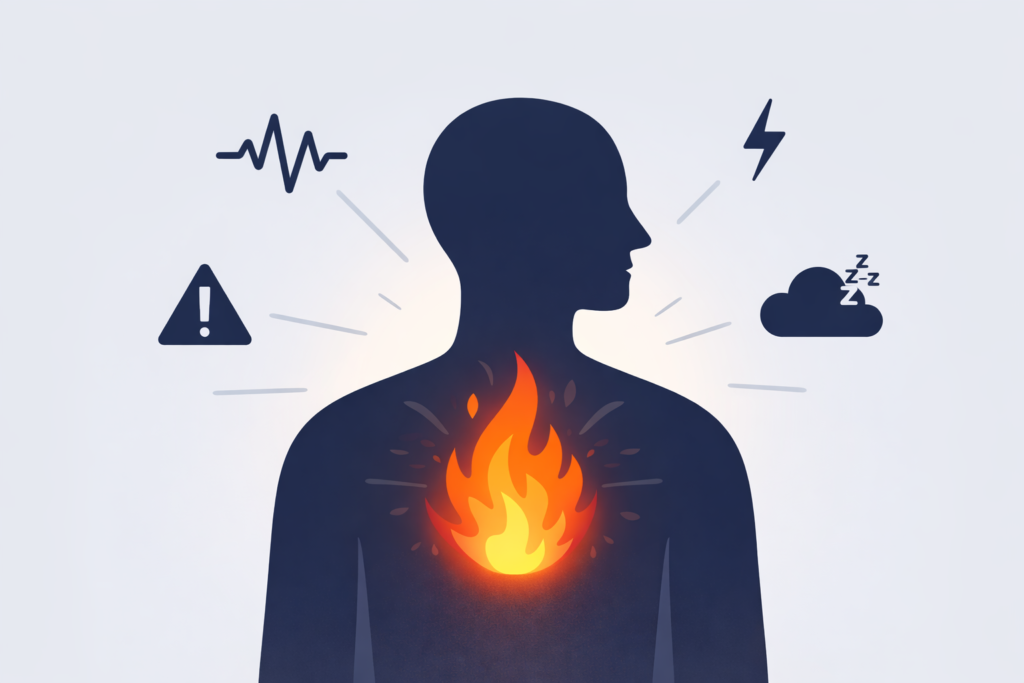
It is the moment when your system says: “I have to be ready.”
Your breathing speeds up. Your muscles tighten and your attention narrows.
This is useful when there is real danger.
But when that stand stays on, even when there is no immediate threat, stress starts silently directing your life Without you realising it.
When stress becomes the background
For many people, stress is no longer an acute spike, but a constant undertone.
You may recognise it:
- you are always “on”
- relaxing feels strange or uncomfortable
- you fret, even when everything seems to be going well
- you react irritated faster than you want to
- sleeping manages, but you don't wake up really rested
These are not bad traits.
These are signals.
Signals that your body has been on edge for too long.
How stress keeps you small without being noticed
What always gets me in conversations with people is this: many of them feel that there are more in them.
- More creativity.
- More freedom.
- More impact.
- More life.
And at the same time they still linger Not because they lack courage.
But because stress affects choices.
Under stress, your system does not choose growth, but safety.
This manifests itself in doubting, procrastinating, sticking to what is known.
You want to move forward, but something inside you slows down.
That “something” is not a lack of willpower.
It is a body that feels no space.
My own story with stress
For years, I thought I was just someone who could handle a lot.
I worked in environments where action, tension and alertness were normal.
I functioned and I performed. But rest was never a given.
Even at times when it was allowed to be calm, my body remained tense.
My head knew: it's okay.
But my system felt something else.
I had insight. I understood where things came from.
But my body did not cooperate.
And that is something I see in so many others today as well.
Why insight alone is not enough
Many people who come to me have already done a lot.
They read. Listened. Talked. Analysed.
They often know perfectly:
- why they do what they do
- where their patterns come from
- what they would like differently
And yet little changes.
That causes frustration. And sometimes shame.
“Why can't I succeed, when I understand it so well?”
But stress works faster than your head.
Always.
As long as your body remains in tension,
automatic responses continue to prevail.
Stress and automatic patterns
Under stress, we slip into patterns that were once helpful:
- pleas
- perfectionism
- control
- carry everything yourself
- keep on
Those reactions are not wrong.
They were created to protect you.
But when they stick around,
they keep you away from peace, freedom and growth.
You can't think them away.
They dissolve only when the body feels safe enough to let go.
What changes when stress decreases
This is the moment when many people are surprised.
Not because something spectacular suddenly happens,
but because change begins subtly.
People then say things like:
- “I react more calmly than before.”
- “I can feel what's right faster.”
- “I doubt less.”
- “I have energy again.”
These are not coincidences.
That is what happens when stress no longer determines everything.
You don't have to force yourself.
You don't have to become someone else.
You come back to yourself, without constant tension.
Stress is not a weakness
What I often see among high achievers is that rest is seen as something for later.
After work. After the success. After the next step.
But rest is not a reward.
Rest is the foundation.
Without rest, everything gets heavier.
With rest, movement becomes more natural.
That doesn't mean you have less ambition.
On the contrary.
When stress decreases, it creates space to create rather than survive.
What if stress is not your enemy?
Stress is not a fault.
It is a signal.
A signal that your body has had to bear too long without recovery.
That your system seeks protection.
When you understand that, you no longer need to correct yourself.
Then you may listen.
And that is where real change begins.